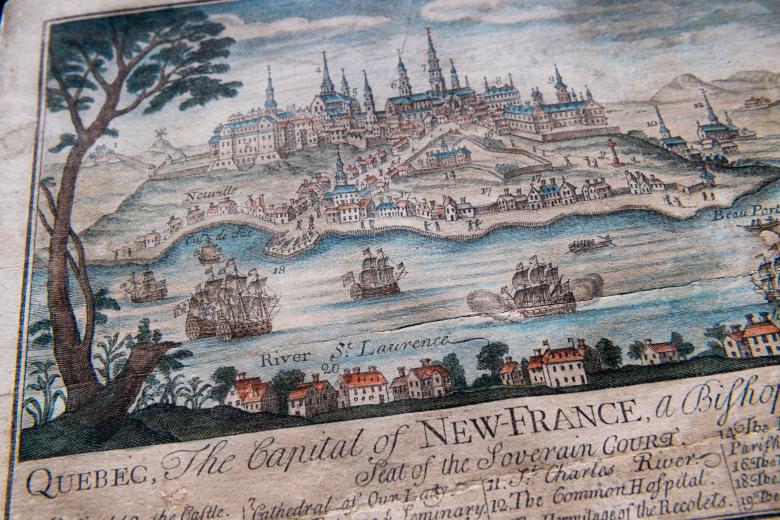
Historical Perspective
First Nations peoples had settled and established trade routes across what is now Canada by 1,000 BC to 500 BC. Communities developed, each with its own culture, customs, and character.
1608
Samuel de Champlain founds the City of Quebec
1615
Arrival of the first Recollets missionaries from Rouen, France. Their mission is to teach christianity to the Indians
1620
Nouvelle-France begins to keep official records of births, deaths and marriages
1625
Arrival of the first Jesuites (among them fathers Charles Lalemant and Jean de Brebeuf)
1627
The Company of a Hundred Associates (Compagnie des Cent-Associes) is given a monopoly for all the land in Nouvelle-France. Their goal is the exploitation of the fur trade and their mandate is the colonization of this new land. The seigneurial system is established. This is an institutional form of land distribution based on the feudal system which involved the dependency of the censitaires (tenants) on the seigneur.
1634
Under the orders of Champlain the Sieur de La Violette travels to the mouth of the Saint-Maurice River to found a fur trading post and a fort. It will become known as Trois-Rivieres
1635
A Jesuit College is established at Quebec (City)
1636
A Jesuit missionary observes the Hurons playing one of their favourite games. He calls it “la crosse” because the curved stick they use when playing it reminds him of a Bishops staff.
1639
The convent of the Ursulines of Quebec was founded by Marie L’Incarnation in what is now Quebec City
1639
Construction began on an agriculturally self-sufficient, fortified mission at Sainte-Marie
1641
Jeanne Mance leads a missionary settlement to New France that includes Le sieur Comeday de Maisonneuve. They establish a settlement in Ville-Marie (Montreal). Mance also establishes what becomes the longest running hospital in North America - Hotel Dieu
1641
The Recollets establish a mission at Sainte-Marie among the Hurons (first Europeans in Ontario)
1641
The beginning of the first French-Iroquois War
1643
In Ville-Marie, Chomeday de Maisonneuve erects a big cross on the Mont Royal to thank God for saving Ville-Marie from a threatening flood
1649
The Iroquois Confederacy began a series of devastating attacks on the Huron nation which leads to their genocide
1649
Sister Marie Morin, the first Nun born in New France
1653
Marguerite Bourgeoys, the first school teacher, arrives in Ville-Marie (Montreal) from France
1658
Marguerite Bourgeoys establishes the Congregation of Notre Dame, the first uncloistered order of Nuns in North America. In April, the first students to attend the school she builds arrive to be taught
1663
A terrible earthquake strikes Quebec City and its area.
1663
King Louis XIV of France takes direct control of the colony and establishes a Royal Government under the direction of his most important minister Jean-Baptiste Colbert
1663
The arrival of the first ship of LES FILLES DU ROI
1663
Election of Jean-Baptiste Legardeur de Repentigny, the first mayor of Quebec City on October 17.
1665
Arrival of the Carigan-Salieres Regiment of 1,300 soldiers on June 19 to fortify the colony. They destroy five Mohawk nation villages, weakening the Iroquois threat.
1665
Jean Talon becomes the Intendant in New France and the colony begins to experience a great period of growth and prosperity
1666
A census conducted by Jean Talon in the winter of 1665-1666 showed a population of 3,215 French inhabitants residing in New France
1666
Ville-Marie (Montreal) now has 582 inhabitants
1666
During the autumn, the soldier of Carignan-Salières, led by Alexandre de Prouville, the "Marquis de Tracy" and the governor, invade the Iroquois territory to the south, burn their villages and destroy their crops.
1667
A peace treaty is signed with the Iroquois
1669
Louis XIV orders that all the men of New France between 16 and 60 years must do their mandatory military service
1670
A British royal charter establishes the Hudson’s Bay Company
1685
New France now has a population of 10,275 inhabitants (compared to about 160,000 in New England)